Can You Wall Mount A TV Without Drilling Holes?
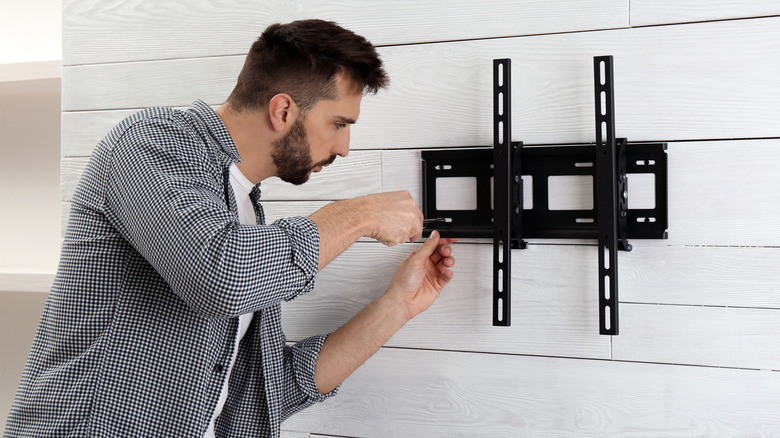
Wall-mounting a TV can be a fairly straightforward process for homeowners that have the right tools for the job. But it’s easy to make mistakes when mounting a TV and if you’d rather not drill into the wall, you may want to go a different route. Luckily, you do have some options though there are some caveats with each one.
Floor-to-ceiling TV mounts give you a wall-mounted look without attaching anything to the wall. These systems use a vertical pole that runs between the floor and the ceiling to support the TV, allowing you to position the screen without drilling into drywall. Some models are designed to support large TVs and use standard mounting patterns, making them a viable option for renters. However, they do require a solid floor and ceiling surface and need enough space for the poles to be installed correctly.
No-stud TV mounts work by distributing the weight of the TV through a bracket system. However, these mounts do attach to drywall using anchors and can still require drilling for other hardware. When installed correctly, they can work for smaller TVs. Some homeowners use adhesive wall brackets to secure the mounting hardware directly to smooth surfaces. But this method is usually not recommended for large, heavier TVs. If the adhesive were to fail at any point, your entire setup could come down. Plus, moving the TV after the fact could be challenging, as the adhesive could leave residue behind.
Alternative TV setup ideas
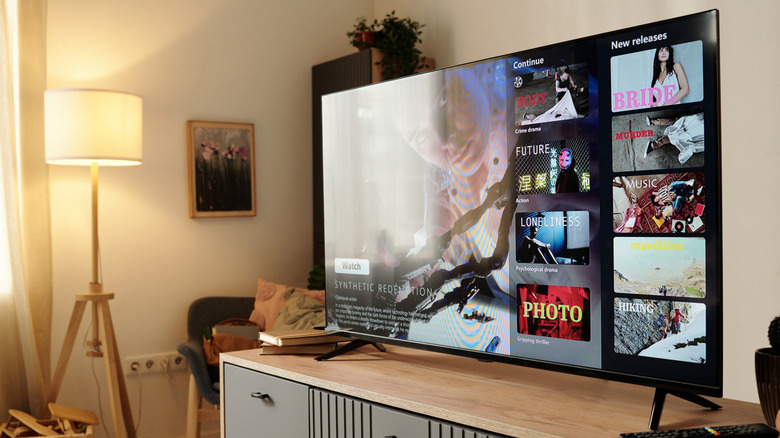
Some people choose not to mount their TV and prefer to use the feet that come with it instead. These feet act as mini stands and typically attach to each end of the TV with screws that can be tightened by hand. This display method has become the industry norm for many modern TVs, as most models don’t have center stands anymore.
Perhaps the easiest drill-free alternative to this TV wall mounting method is a tabletop stand. Aftermarket TV stands attach to the back of the TV like a wall mount and once it’s set up, you can place the TV on top of whatever surface will safely hold it. These stands are versatile, as some of them allow you to change the TV’s height and angle, which can give you a different viewing experience. Just be sure the stand is compatible with your TV’s size, weight, and mounting configuration.
If you just don’t have enough surface area to display your TV, you can use a mobile stand instead. These stands are typically larger than the tabletop version and can be rolled around the room if necessary. Some models include shelves, which are great for holding a gaming console or other entertainment device, and allow all components to remain in one connected setup. However, storing the mobile TV stand when not in use could be a challenge, especially if you’re trying to navigate a smaller space.