Robotic elephant trunk gripper uses camera for touch
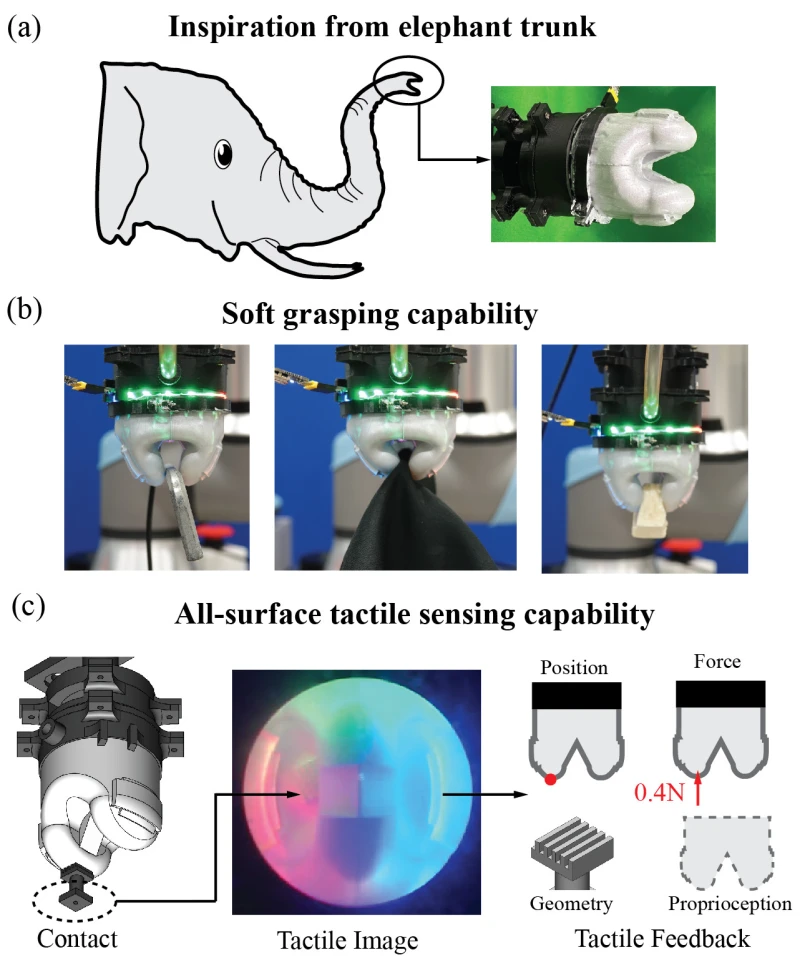
Evolution has already found solutions to lots of problems, so engineers more often borrow ideas from nature instead of reinventing the wheel. We’ve previously seen robots that can curl up like armadillos to protect themselves, and now researchers have developed yet another soft robotic gripper that mimics the tip of an elephant’s trunk. It’s called EleTac and, according to its creators, can actually “feel” the objects it touches.
Existing soft robotic grippers usually rely on external cameras and additional sensors to detect and hold objects. The problem is that once the robotic fingers are wrapped around something, the camera can no longer see what’s happening at the point of contact. Researchers have tried to solve this problem by adding separate sensing layers to the grippers, which gives robots a better sense of touch.
Developed at the Japan Advanced Institute of Science and Technology (JAIST), EleTac takes a different approach: instead of adding extra sensors, it basically turns the entire gripper itself into one giant sensor.
The EleTac gripper is made from a soft, rubber-like material and has two flexible fingers. Instead of using motors inside the fingers, EleTac relies on vacuum pressure. Here’s how it works: when air is sucked out of the gripper through a pneumatic tunnel, the soft walls bend inward, so the two fingers slowly close together and gently pinch an object.
The key innovation is hidden inside the gripper. EleTac features a tiny internal camera placed at the finger-end of the device, and this camera can see how its own “skin” deforms when it touches something. As creepy as this comparison may sound, it’s pretty much like if we had eyes inside our fingertips.
Professor Van Anh Ho from Japan Advanced Institute of Science and Technology, Japan
The built-in camera captures images of how the gripper’s soft layer changes its shape depending on what it is holding. To capture bright, clear images, the researchers installed a ring of 18 LEDs that use green, red, and blue light to illuminate the inside of the gripper. Without this lighting system, the images would be too dark to detect any tiny changes in the soft material.
Taking pictures is only the first step. Hundreds of those images are then used to train an AI algorithm to understand how much force is being applied, what shape the object is, and how bent the fingers are.
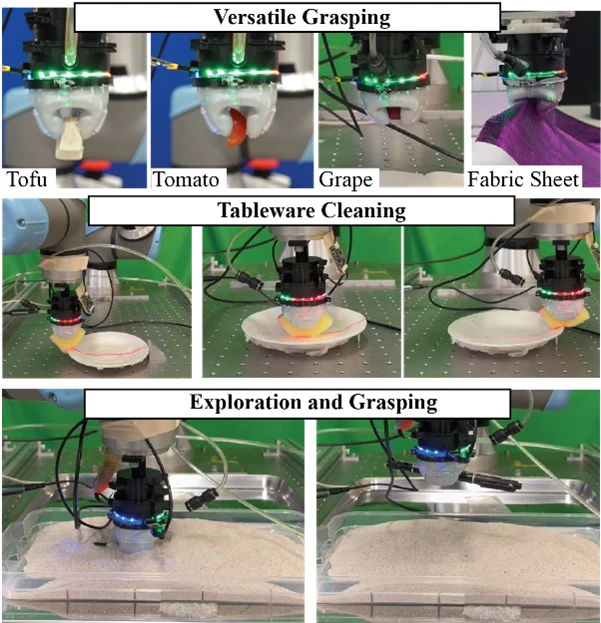
The research team conducted a series of experiments using food items, fabric, and even playing cards. One of the most interesting tests involved making a robot find a pen buried beneath a thin layer of sand. It’s also a good example of why an external camera isn’t always good enough – the pen was not visible at all from the outside. The gripper gently pressed into the sand and relied entirely on its sense of touch. By watching and analyzing how the soft fingers deformed, the AI could tell the difference between touching sand and touching the pen, estimate the pen’s location, and guide the gripper to lift it out.
Professor Van Anh Ho from Japan Advanced Institute of Science and Technology, Japan
Another experiment had EleTac holding a sponge and wiping bowls and plates while adjusting its grip based on tactile feedback. This allowed the robot to hold dishes steadily and apply the right amount of pressure.
The research team hopes this invention will help build the next generation of robots capable of handling delicate objects without damaging them. By combining grasping and touch sensing into a single soft device, future robots could be trained to perform much more complex and demanding tasks than simply washing the dishes.
EleTac elephant-trunk-inspired gripper
Source: JAIST